
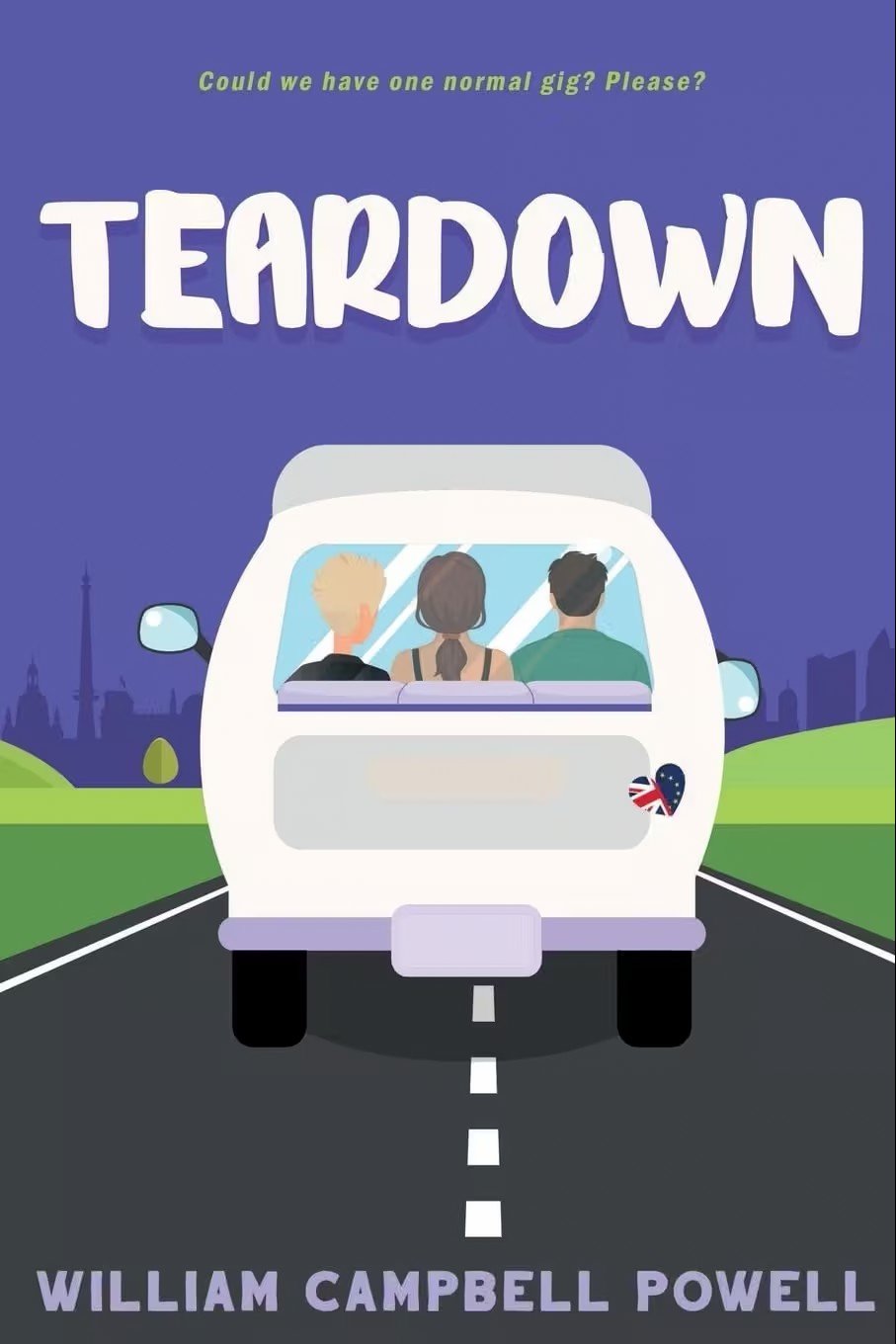
BOOK TOUR: Teardown by William Campbell Powell (Excerpt & Giveaway + Guest Post)
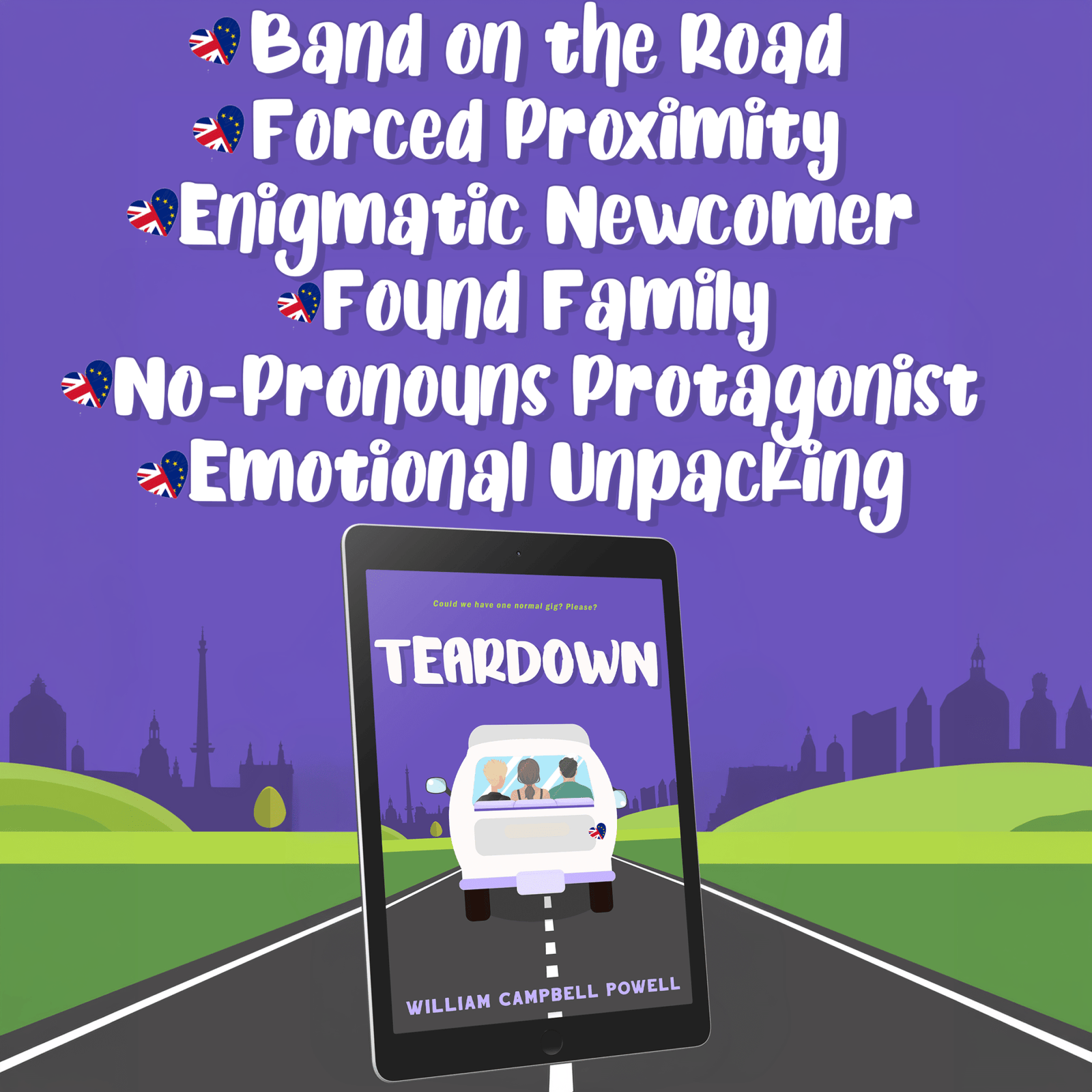
On the road to music fame,
desire and dreams collide.
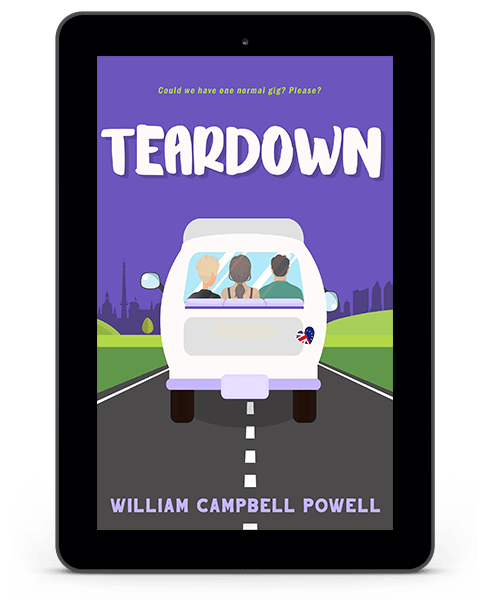
Teardown
by William Campbell Powell
Genre: LGBTQ+ Contemporary Fiction

Growing up in a dead-end, Thames Valley town like Marden
Combe, Kai knows there’s no escape without a lot of talent, hard work—and luck.
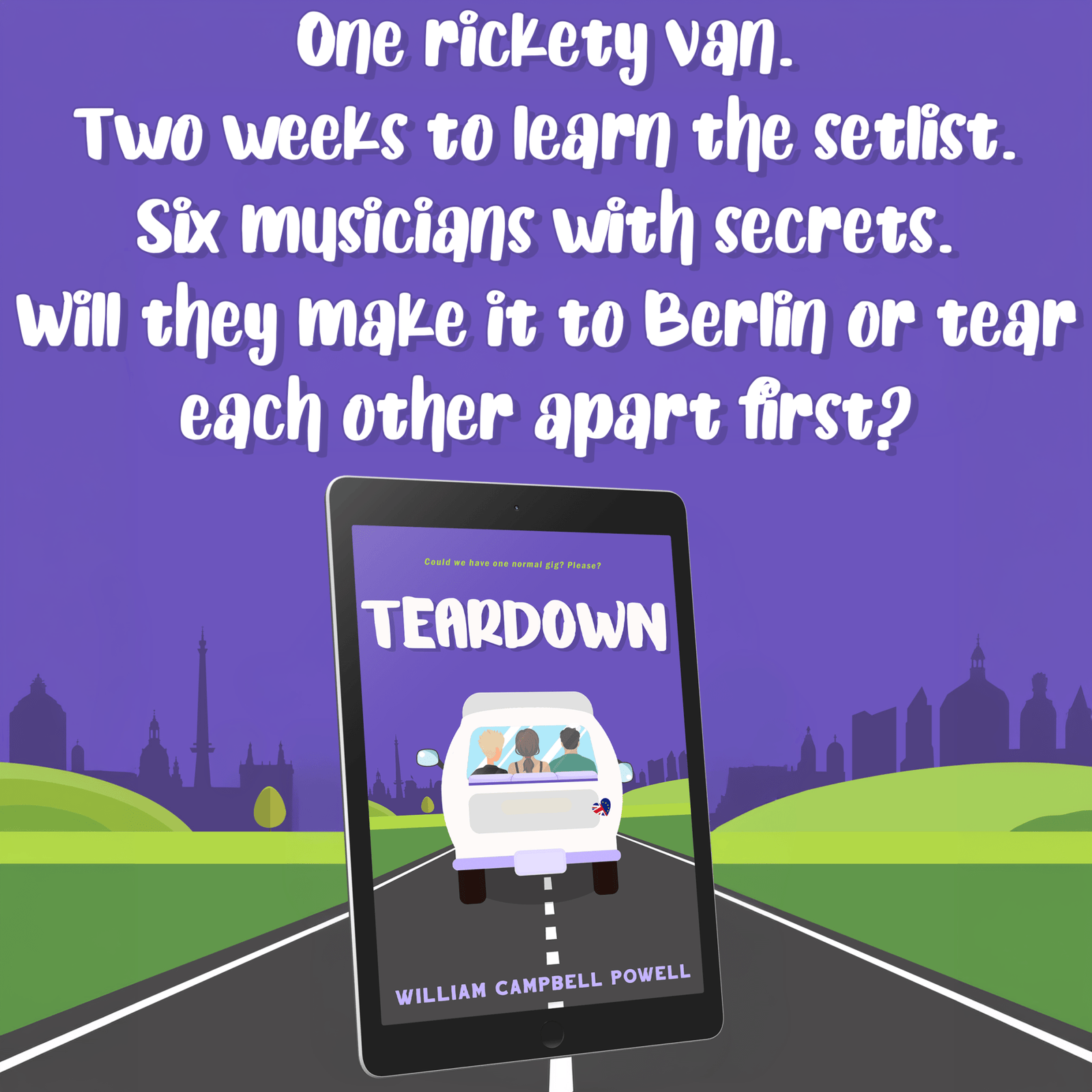
Two weeks before the Clayton Paul Blues Band plans to set out on tour to
Germany, their singer quits, and drummer Kai takes matters in hand. With
bandmates Jake and Jamie, they recruit a talented new singer—the enigmatic
Dominique—as the new face of the band and set out on the road to Berlin in a
rickety white van.
Dogged by mishaps and under-rehearsed, the band stumbles through their first
shows, zig-zagging between chaos and brilliance. But as the first gig in Berlin
draws near, the band begins to gel. They’re clicking with their audience, and
even the stone-hearted Kai starts to crumble under the spell, first of Dom and
then…of Lars.
As the end of the tour approaches, Kai must make hard choices. Dom? But she’s
keeping a dark secret. Lars? Not after the acrimony of their last parting. The
band? Or will that dream crumble too?
**On Sale for Only .99 cents on Amazon!**
Amazon * Books2Read * Bookbub
* Goodreads

Chapter
One
Sunday, September 18, 2016
The Band Hut, Marden Combe
The bus stank of commuters. It wasn’t like a night bus, granted, but
the mix of sweat and cheap scent—and the pungency of diesel—was another
reminder of how much I hated Marden Combe.
A Thames Valley town like every other Thames Valley town, Marden Combe
had a posh, blingy bit, where the bankers, footballers, and celebrity chefs
lived. The rest ran the spectrum from dilapidated through demolished to barely
affordable modern rabbit hutches. The old town centre was closing down, and the
new shopping centre was gridlock hell.
The bus lurched and swung left, past a school named for a long-dead
parliamentarian. Or possibly a royalist. I ought to know; it had been my old
school till I’d turned sixteen. But it had all seemed irrelevant to the more
immediate problem of not getting picked on for being different. There were a
dozen ways and more to be different, whether it was for being too ugly, too
geeky, too slow on the uptake, too shy, too dark, not dark enough, having a
funny accent, or a fundy religion, or being neurodivergent, being too posh,
being too poor, liking the wrong music, or football team, or playing oddball
sports, or using last year’s tech; not liking girls, not liking boys, not
liking either, liking both. Plus others, plus combinations. By more than one
marker, I was weird, and I hadn’t always kept my head down. But there’d
definitely been no bullying at Sir Long-Dead-Parliamentarian School. Or
Royalist, as the case may be. Oh no.
That didn’t come close to summing up the suffocating, hope-crushing,
soul-sucking, shit-brown hole that is Marden Combe. I needed to escape.
If I had a plan, it was that music would save me, as currently embodied
by two pairs of drumsticks in my backpack and the cymbals in their hardcase.
I’d found a few other muzos with a similar plan, and I was heading for the
weekly escape committee meeting.
*
The bus crawled through the town centre—the closing-down bit, where the
last of the character pubs struggled to keep their doors open with, as always,
the pressure on the landlords to boost profits, cut costs, and serve
salmonella-free food, or be booted out with a mountain of debt.
I gave it a nostalgic glance as the bus passed the Lord Nelson, boarded
up and awaiting planning permission for conversion to flats. Once, the very
bricks had rung with rock and oozed the blues. Once. Now, it was just another
live music venue, dead and gone forever.
Still clinging on: the Cherry Tree, where we played a one-in-four
Saturday night residency, alternating with rivals the Dave Green Blues Band,
the twice ill-named Silent But Deadly, and a guest out-of-town band for the
final Saturday. That residency was our lifeline, our oxygen, dependent on our
ability to bring in the punters and dependent on the other bands too. Rivals we
might be, but every band had to pull its weight.
Last night’s gig had been borderline, thanks to the competition from
freshers’ week at the uni. Jeff and Simon had shown the strain as they’d sat us
down after the gig to pay us. A dear old couple, they did what they loved for
bugger-all profit. Simon, a long-term AIDS survivor, was a respected leader in
Marden Combe’s tiny LGBTQIA community. They were never less than friendly to us
as a band or to me personally, but yesterday, Simon got as near to reading the
riot act as made no difference. Times were tough, and if our audience numbers
didn’t pick up…
We got the message.
The lights changed. The bus lurched into motion, taking us up the hill,
towards Marden Combe’s main industrial estate.
*
The bus passed an abandoned car on the grass verge. Last week, a sign
on the windscreen said Police Aware, but evidently, not so aware that someone
couldn’t set fire to it in the interim. That was my cue to get off. I rang the
bell, and the bus pulled to a halt about fifty yards short of a block of
single-storey industrial units. It had been built in the 1960s, and the
brickwork left much to be desired. Ditto the ironwork and the paintwork. Don’t
even think about asbestos. The third unit along was the one I was looking for.
The sign read The Band Hut, and it fit right in with Marden Combe…
I pushed open the door, and all was gloom within. Thick cardboard and
felt covered the windows. I called “Hi” to Wally at the front desk, hunched
over his phone, and the autopilot grunted back. I moved past room 1 (a
folk-metal trio), room 2 (empty), and into room 3, signed with gloss white
paint roughly slapped over its matt black outer door.
Usually, with great rock stars taking interviews in their home studios,
there wasn’t an amp in sight unless it was some boutique marque they’d been
paid to endorse. The studio would be airy, bright, and wood-panelled in glossy
pine, with walls featuring three or four iconic guitars. Double-insulated patio
doors would lead onto a beautifully manicured lawn, the whole set tastefully in
the Cotswolds.
In Marden Combe, they did things differently. Black felt covered the
walls and ceiling of Studio 3. Underfoot, recycled carpet tiles clung to my
shoes, sticky as only years of spilt beer could accomplish. Worn and curling
patches showed where the bass drum spikes had caught between two tiles and
where the studio’s cobbled-together frankenamps had been dragged too many
times. Gaffa tape glinted under fluorescent lights, hasty repairs
criss-crossing the floor. Other marks—cigarette burns mostly—clustered round
the amps; the still-potent reeks of ancient tobacco and stale weed lurked at
the edge of awareness. A tired but eclectic collection of posters hung on the
walls, providing a potted archaeology of Marden Combe’s indigenous music of the
last half decade.
Jake was already set up and sitting on a Band Hut amplifier, cradling
his beloved Fender Stratocaster. He didn’t look up, but I didn’t expect him to.
He hunched over the fretboard, fingers spider-dancing their scales. Half in
shadow, he was a little spiderlike himself, all spindly limbs that gangled and
writhed. His hair, too pale for a spider, was cut short and neatly combed.
After a minute, he finished his phrase, and we nodded to each other.
Jake wasn’t a great conversationalist, so I didn’t push him out of his comfort
zone. It was called ‘letting the music do the talking’. It suited both of us.
It took me about ten minutes to get the studio’s drum kit set up the
way I like it, with my own cymbals in place. All the while, Jake happily
noodled on his Strat. Clay breezed in just as I was finishing up.
Clay was the kind of guy you’d want fronting a blues band. Beautiful,
with ebon-black skin and close-cropped hair, he had a solid baritone voice with
a growl that went up to eleven. Today, he wore jeans and a T-shirt from a Kyla
Brox show, but on stage, he was sharp-cut suit and moves. Twenty-six
years old and—speaking entirely in my capacity as detached observer—hot and
classy as fuck.
“Hi, Clay,” I called.
“Hi, Kai. Where’s Jamie?”
“He said he’d be a few minutes late. The boss is making him do
overtime.”
Which, given that it was Sunday, was brother Jamie’s standard polite
fiction for his housemates roping him into cleaning the kitchen. A little
unfair, given that Jamie is possibly the tidiest human being on the planet. If
Clay had been thinking, he’d have remembered that.
“That’s a bugger,” said Clay.
“Yeah. Tell me about it.”
But then he just stood there. Like a kid busting for a pee but afraid
to ask the teacher.
“D’you need a hand getting stuff out of the car?” I asked.
“No.” He held up the flight case that held his mic and harmonicas. “How
long do you think he’s going to be?”
“I don’t know. He said a few minutes, but I’ve no idea what that is in
real minutes.”
Clay sat on an amp, then got up and walked over to the soundproof door.
He opened it and the second door beyond it. He peered through the gloom. I
could hear the folk-metal band getting into their groove, and good luck to
them, but I was glad there would be a vacant studio between us and their
sawtooth D minors.
No sign of Jamie though.
It was like something was up with Clay. I was almost tempted to ask him
if he was okay. But what if he said no? That was why I didn’t ask personal
questions within the band. We played blues together, and we planned escape. We
memorised the names of one another’s significant others so we could be polite
if they showed up at a gig. Clay’s significant other, Sirelle was—again, in my
capacity, et cetera, et cetera—hot, but she was also Little Miss Disdain. Jake
did not have a significant other that wasn’t made of wood and didn’t have six
strings. Jamie had been a sore test of memory up until Louise, but he was
currently unattached. That was it.
Clay was making me nervous though. So:
“Are you going to set your mic up, Clay? I’ll help you set levels so
you’re all ready to go when Jamie gets here.”
No reason he couldn’t do it himself, but I was also music tech, so I
was allowed to ask.
“Uh, no.”
Then, he expelled a deep, doom-laden breath, and I knew this day, which
had started only medium crap, was going to end full-on shitstorm.
“I can’t wait for Jamie,” he decided. “Ah, guys…I’ve got an
announcement to make.”
Jake looked up but carried on playing irritating little shreds.
“Good news?” I asked, more in forlorn hope than expectation.
“Well, yes. Sort of. I’ve got a new job.”
That doesn’t happen a lot in Marden Combe. Let’s not piss on the parade
just yet.
“That’s good. Well done. So, what’s not to like about that?”
“It’s…in London.”
“Good pay, then, I guess. But I don’t fancy your commute.”
“Oh, it’s not Central London. It’s in Acton. But you’re right about the
commute. Apart from that, though, it’s a pretty good job. It’s a real step up
in my career.”
It was my turn to take a deep breath. “Okay. So why aren’t you dancing
for joy?”
“Well, it’s a big project, and they need to get started right away. So,
I’m starting next week. There’s no flexibility on that date. We’re up against
the wire.”
“Right. What happens when you go on holiday the week after? Are they
okay with that?”
“That’s just it, Kai. This is a huge project. It’s a fantastic
opportunity. I’ll be in right at the ground floor. I need to be there. I’ve
promised them I’ll be there.”
Ah. This is goodbye, then. Why can’t you just fucking say it?
“So what happens to the Clayton Paul Blues Band? What happens to the
tour? Köln, Aachen, Berlin? All those German punters waiting to see us two
weeks from now?”
Clay wouldn’t meet my eye.
“I can’t pass this up, Kai. It’s a dream opportunity for me.”
“And you can’t wait?”
“They won’t wait. I aced that interview, but there’s a bunch of
guys almost as good, ready to start tomorrow. White guys.”
“That shouldn’t matter. There are laws…”
“Shit, Kai. Don’t tell me you don’t know how discrimination
works. The manager liked me, stuck his neck out to make the offer. But if I
start pissing them about, making conditions… It wouldn’t be discrimination,
no sir. But it would be ‘we need someone who can start
immediately’—that’s what they’d say.”
I nodded. I did know. White male privilege, Kai. “And the band?
Your band. Us. The Clayton Paul Blues Band that goes on tour in two weeks?”
“I don’t know.” It was a scream of desperation, and it made Jake stop
shredding. Something had gotten through to him.
“I don’t know,” Clay repeated, quieter. “It’s just a tour. It’s not the
fucking Beatles going to Hamburg to find their destiny.”
“No, it’s not. In the great scheme of history, it’s just a piece of
fun.”
“Well, then. You’ll get over it.”
Eyeroll. Do you know how crass that comes across, Clay? And a
deep breath.
“With the greatest of respect, Clay, fuck you. I do not plan to ‘get
over it’. I said it’s just a piece of fun, but that’s why it matters. Marden
Combe is a shithole of the first water. Nothing happens here. Nothing good has
ever come out of here. If we stay here all our lives, dying will be the best
thing that ever happens to us.
“So yes, it’s a piece of fun. And no, it’s way more than that. It’s the
hope of escape. It’s the dream in our waking lives that makes all the crap
worth enduring—the crummy job or the even crummier no-job.”
A father who was too distant. A step-mom who was too close. But I
didn’t say it. Nobody else’s business.
Clay shook his head. “I can’t be responsible for the crap in your
lives, Kai.” It was a whisper.
Jake turned back to his guitar and started adjusting his pedal board.
He wasn’t going to get involved if he could help it.
“Okay,” Clay continued, “you’d better cancel it—”
“Your band. Your tour. Haven’t you got the balls to cancel it
yourself?”
“I thought…you could find a stand-in for the tour. If you wanted it
that much.”
“A stand-in? And keep the band going afterwards, Clay? Is that what you
want? This band as your bolthole, waiting for you to return when the new job
settles down?”
I let that sink in, then asked him, “Can you commit to that?”
“Shit! I don’t know.”
“Don’t know? Or don’t want to tell us?”
“Put it on hold. We can put the band on hold, can’t we?”
“How long for?” I asked him.
“I don’t fucking know! I’ll be flying over to the US quite a bit. And
there’s a bunch of guys in Japan I’ll need to work with. Six months, maybe?”
And then it hit me. I knew why Clay couldn’t meet my eye.
“The Cherry Tree. You must have known about this last night, and you
didn’t say a fucking word. We’re already in the Last Chance Saloon. This is
Boot-fucking-Hill.”
I’d struck true. His mouth hung open, and the longer it stayed that
way, the more certain I was.
“Y-yes, Kai. I had the offer, but I didn’t know if I was going to take
it. Honest, guys. But I thought it over, slept on it, and knew I had to take my
chance.”
Well, it might be true, but my money was on Clay being too
chicken to stuff the band in front of Simon. It had been too long a pause,
while he crafted a damage-limitation lie.
“This’ll cost us our Saturday slot,” I said. “You know that, don’t you?
Simon knows we won’t find a new singer in time.”
“One of you could—”
“Simon’s already got a plan to fill our slot, else he wouldn’t have
given us ‘the talk’ last night. He’s a lovely guy, but he’s a businessman too.”
“He wouldn’t do that to you, Kai. You’re one of his golden…kids.”
Well, it was true, about being a ‘golden kid’ at least. Simon had taken
me under his wing when I first got the notion I might become Kai. But that
didn’t change a thing because Simon taught self-reliance and owning the
consequences even while he was still putting the pieces back together, with
himself as the prime example.
“You know better than that,” I said. “He owes the band nothing. He owes
me nothing. And neither of us would have it any other way.”
But I did owe Simon. Maybe what I owed him was enough notice to give
another band a clear shot at the residency.
Which was all very noble but not the issue at hand. Time to wrap
this shit up, Kai.
“You said six months,” I began.
Six months. Six months without a band. I felt the dread rise up like a
wave, ready to pull me under. The Clayton Paul Blues Band was my life.
Had been my life.
Six months though. Six months was more than enough time to build a new
band. If I could pull the rest of the guys through.
Jake was in shock, biting his lip. His eyes darted about the room, to
me, to Clay, back to the fretboard, where spider fingers shaped chaotic chords.
“No good. Jake, you don’t want to be six months without a band, do
you?”
Jake put on his best rabbit-in-headlights gurn.
Bad move, Kai. This isn’t ‘pulling the guys through’.
But maybe I hadn’t screwed up. Maybe Clay sensed that the worst was
over.
“No, you’re right,” he said. “It’s not fair to ask you to wait. It’s
been a blast with you guys, but all good things come to an end.”
He held out his hand. “Kai? No hard feelings? Maybe play together
someday when all this is done?”
I shrugged. But…why burn bridges? If I’d had the chance, wouldn’t I
have done the same?
“Maybe.” I shook his hand. “Good luck with your escape from Alcatraz,
Thames Valley. And don’t cancel the tour. I want to think about that.”
He shook hands with Jake too. There was an awkward silence. Jake went
back to his guitar and began dabbing harmonics.
“Look, guys,” Clay said. “I’d like to stay and say goodbye to Jamie,
but I guess you’ll want to talk over what’s next, and you won’t want me around
for that. I’ve paid the Band Hut man, so the room’s yours till ten o’clock
anyway. Least I could do. Okay?”
The Band Hut man. Clay, his name’s Wally. He’s been the set-up guy
for two fucking years here, and you can’t be arsed to remember his name.
Clay’s harmonicas and microphone were still in his flight case,
unopened. He picked the case up, squared his shoulders, and left the Band Hut,
leaving us to pick up the shards of a blues band.
Fuck.
*
Jamie wasn’t best pleased when he arrived a few minutes later.
“No Clay? I thought I saw him driving past as I got off the bus. What
happened?”
Jake let me do the explaining. When I’d finished, Jamie’s comment was
brief.
“Stupid bugger.”
Huh? I expected more support from my brother than that. Jamie saw my
worried frown.
“Easy, Kai. I didn’t mean you. You were right to force the issue. He
wants us to give him a free pass back into the band if it all goes tits-up. No
dice. Shame about the tour—”
“Yeah. Shame Clay’s going to miss it.”
Jamie started to say something, but I rode right over him.
“I’ve been thinking about it, guys. We’ve put a lot of work into
rehearsing for this tour, and I don’t want it to go to waste. It’s a vital part
of the Plan.”
The Plan, which was to practise like crazy and hone the set with a
tour—yes, like the Beatles, but in less time. We had Deller Studio A booked in
Oxford for our return, ready to record a sizzling demo to impress the A&R
men in London. Get a record deal. Spend the rest of our lives playing music and
counting money. And spend it somewhere that was not Marden Combe.
Meanwhile, Jamie was being practical. “But we’ve got no singer, no van,
and no driver…”
“Hey, we can fix that stuff. Advertise for a singer. Find one who can
drive a van. Hire a van.”
“That takes time, Kai.”
“We’ve got two weeks. One of us could sing.”
“Not like Clay.”
Jake perked up. Shit! The slumbering giant awakes…
“Yeah. What Kai said. One of us could sing.”
But not you, Jake. Please, not you. Behind Jake, Jamie rolled his eyes. One thing we
agreed on.
“There’ll be a lot of admin too,” said Jamie.
“I guess that’s mostly me, then,” I replied. “You guys have got day
jobs.”
Jamie nodded. “Jake—anything else on your mind?”
“Yeah. Can we play now, bossman?”
“Yeah. I think we need to.”
I fussed around with the drum kit a bit for the sake of something to
do. Jamie plugged his bass into the studio’s amp and twiddled a few knobs until
it sounded okay.
No microphone. Clay had taken his away with him. So I begged Wally, the
front desk guy, to find us a decent mic.
And, of course, with budget rehearsal studios, nothing’s free;
everything’s an extra. Wally played hardman with me. He took the tack that,
yes, Clay had paid, but that didn’t include unlimited mics. He pointed to the
price list on the wall.
“Ten quid, Wally? You cannot be serious. Show me something that’s worth
that much.”
So, he reached into a drawer and pulled out an offering. “It’s a Shure.
Top-line mic.”
I shook my head. “It’s a fucking museum piece. Look—the windshield’s
dented. Somebody’s dropped this, hard. And the lead’s missing a grub screw. You
can’t charge ten quid for this shit.”
He opened his mouth to reply.
I wagged a finger at him. “Here’s five quid and a five-star review for
your customer service. Promise. Okay?”
“Done.”
I set up the mic—it crackled, and I wondered whether I’d sold my review
too cheap. We argued about who’d go first, and Jake won.
Live, we always set up a special mic for Jake to do backing vocals. I
mixed it up, prominent in the stage monitors, but it didn’t go anywhere near
the main bus. We endured it so the audience didn’t have to.
That trick wasn’t going to work in the studio though. We had to be
fair; we had to let him try. Jake gave it his all.
“‘Serves You Right to Suffer’, guys,” he said, grinning and bizarrely
aware of the irony of his audition choice. “John Lee Hooker.”
Indeed, a prophetic choice. Jamie and I set up a slow blues pattern,
and Jake dived in on guitar, catching the groove. He took the guitar down to
nothing and growled the opening lyric. Then he searched for a pitch, found a
note he liked and hung on to it, while Jamie struggled on bass to find the key
he’d chosen. Then Jake played a riff in the original key, clashing horribly
with Jamie’s bass. Jake glared at Jamie, who reverted to the original key.
Jake choked the guitar back again. His voice found another note he
liked. This time, Jamie stuck to the original key and earned another black look
from Jake. It went on like that a long time, back and forth between random
keys, and whatever Jamie did was wrong. After a couple of verses, Jamie
launched into an unmistakable this-IS-the-end-of-the-song fretboard run before
Jake had a chance to start a new verse.
Jake turned to me. I guessed Jamie was in all kinds of bad books for
pissing about with the bass line.
“How was that?” he asked, puppy-dog eager to start his new singing
career.
“That was…astonishing, Jake.”
It was all I could think of to say. It was even true. Technically
‘astonishing’ could mean bad as well as good. But as I saw a puppy-dog joy fill
his eyes, I knew I’d said the wrong thing. The unvarnished truth would hurt him
deeply.
Jamie saved me. “What happened to the guitar, Jake? I don’t think I
caught much guitar.”
“That? No. I guess it was a bit sparse.”
“We do need your guitar. Very much.”
“I’m not sure I could do both. I could learn.”
I jumped in. “Let’s make it our plan B.” By which I meant our plan Z.
“Your guitar is too important to our sound. Jamie? Did you want to try?”
Jamie liked to bounce about on stage, so I couldn’t see how that was
going to work, live. Despite that, he wanted to try out, so we ran through a
couple of numbers. He wasn’t bad—we already knew his pitch and timbre were good
enough for backing vocals—but he wasn’t happy.
“You don’t have to tell me, guys. That was shit. I can’t syncopate
against the bass line. I can’t put any feeling behind it. Not the way Clay
could. Your turn, Kai.”
So I pulled the mic stand around to the side of the kit, set it up so
it didn’t get in the way of the hi-hat, and we gave it a go. I picked ‘I Come
from the Blues’, which was one of Clay’s compositions. It had fallen out of the
set sometime in the last six months, but I loved Clay’s soft, jazzy
butterscotch vocals on it. If it had been up to me, it would still be in the
set, but Clay had said he wanted to move on.
Where did I come from? I come from the blues.
Where am I going? I’m going to lose.
Where is my future? I’m sure I have none.
Where is my hope? My hope is all gone.
I’ve always sung along—off-mic and under my breath—so I didn’t have any
trouble fitting the words in the right places. And I’ve got decent pitch and
rhythm. So I think I did all right.
Now, Jamie wouldn’t meet my eye.
“What?” I demanded. “What was wrong with that?”
He mumbled something.
“I can’t hear you, bro. What did he say, Jake?”
Jake looked away. He didn’t want to get involved in any squall between
me and my brother. Besides, he’d used up all his words for the day.
“I’m not sure how to put this, Kai. You’ve got a good voice. It’s,
well…not very, well, rock’n’roll. No…grit. Too pure. Sorry.”
“I see.”
“Look, we’ll ask around our friends. Social media. There’s got to be
something online.”
I didn’t say anything. I was thinking lots though. About how I’d
discovered that this was something I really wanted to do. And could do. All
that bullshit about ‘too pure’—no, my voice was good. Damn you, Jamie. I will
sing. In this band, if possible. If not…
The rest of the practice was conducted with icy politeness. We mostly
played instrumentals. Jamie sang the few bits where we absolutely needed the
vocal cues. I sat behind the kit pretending to be okay.
It was crap.

What are your top 10 favorite books/authors?
Dandelion Wine by Ray Bradbury
Lord of the Rings by J R R Tolkien
The Art of a Lie by Laura Shepherd-Robinson
Just about anything by Terry Pratchett
Espedair Street by Iain Banks
The Culture books by Iain M Banks
Firedrake’s Eye by Patricia Finney
The Alexander Trilogy by Mary Renault
The Book Thief by Markus Zusak
The Left Hand of Darkness by Ursula K LeGuin
What book do you think everyone should read?
Everyone needs to read The Book Thief by Markus Zusak.
How long have you been writing?
Since the late 1990s. I look back on those early works as an apprenticeship, when I was learning what works, find my voice. I began the work that became my first published novel in 2006. I got a revise and resubmit with it in 2010. The revised version was accepted in 2012, and published in 2014. It was a long road.
Do the characters all come to you at the same time or do some of them come to you as you write?
As a pantser – a writer who doesn’t plot everything out beforehand – it’s pretty common that a work starts with just a single character – usually the main character, unless it’s a murder mystery, when it can be the victim. The second character follows pretty quickly, as the main character needs someone to talk to.
The first scene I wrote for TEARDOWN was for a moment much later in the book with Kai and Dom alone together, trying to keep warm on a very chilly night in a German town. It was a ‘waypoint’ scene – once I’d written it, it set the direction for all the earlier scenes to work towards. With the waypoint in place, I then went back to the very beginning and worked out the basic band and the crisis that sends them off into Germany with an untried line-up and began adding new members to add tension – not least by filling the van up to capacity and beyond.
What kind of research do you do before you begin writing a book?
I do very little research before writing. Once I have an idea for a book, it’s top priority to get the story down as a first draft. Stopping to do research is fatal in first draft – it kills the momentum of writing. Once first draft is done, it all changes. The first edit pass is all about establishing a coherent plot from beginning to end, and there’s a significant measure of research that happens at that point. But there’s more research that happens in later edit passes, where the focus is on the little details that give the story colour. As an example, I decided I needed a national holiday to happen on the Monday immediately following the band’s first Berlin gig, with the obvious holiday being 3rd October – German Unity Day. So that required that I set the novel in 2016, which raised questions like whether X was still called Twitter at that time (it was).
Do you see writing as a career?
Perhaps it might have been if I’d found an agent when I sold the first book, but I was very much at the top of my career in Software Engineering at the time. So no, writing is a hobby that is also a business. It’s more fun that way.
What do you think about the current publishing market?
Don’t get me started! But it’s harder – a lot harder – to get noticed now than when I first started submitting EXPIRATION DAY. Digital publishing has made it far easier to get a book out there, but the market feels flooded, and it’s harder to stand out. Add in AI, and it gets harder still, as unscrupulous writers use AI to churn out tens of books in not many months.
Do you read yourself and if so what is your favorite genre?
I used to consider myself a science fiction (and fantasy) reader, which tallied with the first book I published, as well as the short stories I’ve published. But I’ve always enjoyed crime and historical fiction, and I’ve been writing in those genres too.
Do you prefer to write in silence or with noise? Why?
My first choice is silence for writing, but if I can’t have silence, then the sounds of nature and ordinary life. If neither of those, then I’ll choose some instrumental music, such as a Mozart Serenade.
Do you write one book at a time or do you have several going at a time?
Usually it’s one book at a time – or at least staying with the current draft until it’s done, then switching to another book for its next draft (to let the previous draft rest). However, when I’ve got two competing ideas for a novel, I’ll write both until I’ve got 8,000 words done in each and decide which has ‘legs’, or else until I’ve abandoned one.
Pen or type writer or computer?
Pen is for notes – I keep a notebook next to my bed, so I can capture ideas that pop into my head when I should be sleeping. Sometimes I can even read what I’ve written the following morning. I’ve owned typewriters, but they went before I started writing ‘properly’. I wrote in MS Word up to EXPIRATION DAY in 2014. In 2015 I discovered Scrivener and I’ve been using that ever since.
A day in the life of the author?
I try to start every day with some reading (over breakfast) before I start writing. And because writing isn’t my job, there are always real jobs to get done (even though I’ve now left the world of work behind) before I can write. Writing, for me, includes writer-related things like reading the work of other writers. I have made a conscious decision to prefer the work of living writers, particularly in the books I buy. Dead authors really don’t need my money.
I give priority to reading anything from my own writer network: my SF peer-critique group and my wider network of author friends. Sometimes I’ll do deeper edit work for those friends or a beta read.
Failing that, I’ll look at my bedside notebook, to see if I’ve had any brilliant writing ideas I need to decipher and/or act upon.
I may have urgent edit deadlines I need to work on, whether for my own writing that’s with a publishing editor, or for feeding back to my writer network, which may have attached deadlines.
If not, I’m probably free to do a couple of hours writing (or researching) for whatever work of mine is active.
Advice they would give new authors?
A lot of my advice is don’t-do:
- Don’t go back to what you’ve already written until you’ve completed the first pass and got the story down.
- Don’t worry about plagiarism, other writers stealing your ideas. Ideas are not stories, and they’re not as original as you think. The story is what you do with the idea – the characters and the plot. That can’t be stolen – it is unique to you.
- Don’t use AI. Specifically, don’t use LLMs. The publishing industry is opposed to it. It’s OK to use grammar and spelling checkers, because they’re still your words and your decisions, rather than some ghastly composite of every writer who’s ever had their work stolen by AI.
What makes a good story?
Balance. Justice. And change – a journey. Two journeys, in fact. My touchstone here is Jessica Brody’s ‘Save the Cat Writes a Novel’. In this model, there’s an A Story and a B Story. The A Story is the adventure that you’re taking the reader on. It’s evil villains, the quest for the magic artifact. It’s a heart to be won, or the crime to be solved. The B Story is the internal journey of the main character(s) as they turn from sit-at-home types into dragon-slayers (or dragon-befrienders) with all the skills and perseverance (and maybe a found-family) to achieve the desired result (which they would not have been able to achieve immediately from sit-at-home).
Justice is achieved relatively easily. The crime is solved. The villain is behind bars. Restitution is performed. Wrongs are righted.
Balance is what lifts a story out beyond justice to ‘chef’s kiss’ perfection. Balance mirrors the story’s beginning at the end. You look at they story’s final scene, and your first thought is ‘isn’t this where they started?’, but then you look at the scene more closely, and you see that an underlying reality has changed to something that wasn’t possible before, by virtue of the internal journey. The main character isn’t the same person who started the tale – they have been transformed by that journey.
What are you currently reading?
I’ve just started reading ‘The Last Contract of Isako’ by Fonda Lee. I loved her ‘Green Bone Saga’ and this has a similar feel, while being set in a totally different universe.
What is your writing process? For instance do you do an outline first? Do you do the chapters first?
For a single novel, I find the following is approximately my process:
Pass 1 – get a basic story from act 1 to act 5. There will be huge plot holes and inconsistencies unresolved. This is, however, the pass where I build character profiles as I go. It’s part of why I use Scrivener. Many writers say this is the pass when you tell yourself the story, and the remaining passes are where you learn how to tell it to an audience.
Pass 2 – resolve the plot holes, the motivations, maybe add, combine or remove characters. Diagramming tools (Scapple) may help me visualize the structure. Manuscript (MS) stays about the same length.
Pass 3 – trim the opening, which always has far too much scaffolding (infodumps, telling). Build in the full sensorium – ‘paint’ the white rooms in colour, texture, taste and smell. Despite the early culling, the MS will grow overall.
Pass 4 – Intensity mapping – where are the dull scenes, where does the novel drag, where does it get so intense that the poor reader will need a break? This is where stuff gets chopped.
Pass 5 – Readbility, using tools like MS Word’s text-to-speech, hemingwayapp.com. Spotting places where dialogue attribution is unclear (or just wrong). Few changes to overall length.
Pass 6 – spelling and grammar. Few changes to overall length.
Then give the novel to beta readers and/or professional editors and merge feedback where and if appropriate.
What are common traps for aspiring writers?
(see above ‘Advice they would give new authors’)
What is your writing Kryptonite?
Wikipedia. (Or more generally, the internet.) Researching details can consume hours of time, when I could have written thousands of words, rather than producing one factually correct sentence.
Do you try more to be original or to deliver to readers what they want?
I write as the muse directs. There’s no pattern to my writing. Every novel to date has been a different genre to any previous novel of mine, except my (unpublished) life of King David had to be split into 2 volumes.
If you could tell your younger writing self anything, what would it be?
Get an agent, Bill. They’ll do all the hard work around publicity. (It’s partially true, at least.)
What’s the most difficult thing about writing characters from the opposite sex?
I’d hold my hand up and admit that I when I started TEARDOWN I didn’t really appreciate the level of harassment, discrimination and sexualisation that so many (all?) women suffer in this male-dominated world. It’s why I make sure to get sensitivity readers among my beta readers, who aren’t shy to tell me, no, life’s not like that for a woman.
The same is true, of course, for writing any marginalized person, whether through race, disability, age, sexual orientation, or other protected characteristic.
How long on average does it take you to write a book?
To write the first draft of a book takes me one or two years. I’ll then follow that with at least another five edit passes, each focusing on a different aspect of the story (coherence, plot, trimming the opening, adding taste, smell and other sensory information, context and place, spelling, overused words, infodumps. Each of those passes can be easily three months, after which I’ll take a break and work on a different story. So it’s not hard for 3-5 years to elapse before a novel is ready to query. If any writers are interested, I’ll point you at https://wordslayered.wordpress.com/2025/11/03/from-initial-spark-to-the-printed-page/
Do you believe in writer’s block?
Of course. I’m currently stuck on part two of a portal fantasy novel. I know the broad outline of what needs to be done, which involves saving a universe (or two), but I haven’t got the launch point sorted. I may have to write an actual outline. Gasp!

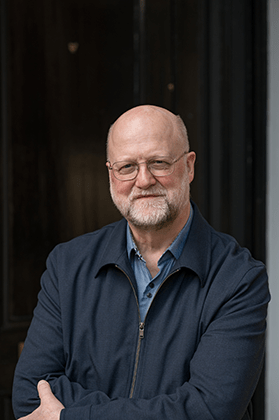
William lives in a small Buckinghamshire village in England.
By night he writes speculative, historical, crime and other fiction. His latest
novel – TEARDOWN – is published by NineStar Press and is widely available in
eBook and paperback formats. Previously, his debut novel, EXPIRATION DAY, was
published by Tor Teen in 2014 and won the 2015 Hal Clement Award for better
than half-decent science in a YA novel – the citation actually says
“Excellence in Children’s Science Fiction Literature”. His short
fiction has also appeared in DreamForge, Metastellar, Abyss & Apex and
other excellent ‘zines. By day he writes software and in the twilight he sings
tenor, plays guitar and writes songs.
Website * Facebook * X * Instagram * Bluesky * Bookbub * Amazon
* Goodreads

Follow
the tour HERE for special content and a giveaway!
Enter the Teardown Giveaway Here


You May Also Like
DESERT ISLAND CASTAWAYS: B.A. Tortuga

MUSIC MONDAY: Common Sense by Viagra Boys
