












-
if anybody knows the song here and what type/genre is it please let me know. i want to look for more songs like this.
-
The Gentleman with Thistle-down Hair
Fave character from Jonathan Strange & Mr. Norrell:
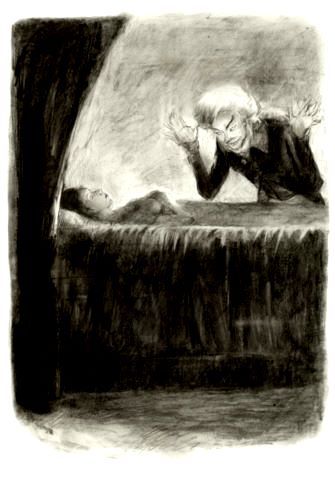
The gentleman with the thistle-down hair, whose real name is not known*, is a fairy that rules over the fairy kingdom of Lost-Hope (and possibly others). He was first seen when Mr. Norrell summoned him early on in his career to bring Lady Pole back to life, and gains his name from his silvery-white hair, apparently his most prominent feature. He looks handsome and thin, has all the magical abilities of any fairy and indeed may be more adept at them than a normal one, though he can be exhausted after using a particularly powerful spell, like the Pillar of Darkness enchantment he cast upon Jonathan Strange[55].
Appearance
We are told that he is tall, handsome, has a particularly pale skin, cold blue eyes, and dark eyebrows that end in an upward flourish [8]. (Some aspects of his appearance may be generally characteristic of fairies, as one of the soldiers in the Fairy Host which accompanies the Raven King in his conquest of Northern Englandin the 12th century, and who is responsible for the exsanguination of the Maid of Allendale, is also described as very pale, blue-eyed and with brows having “a curious flourish at the end”. But it is of course conceivable – fairies being well-nigh immortal – that this is in fact the Gentleman himself at an earlier point in life[45].) We later learn that the Gentleman is exactly the same height as Jonathan Strange [26], which is to say rather taller than average. His clothes are always spotless, fine and in the height of contemporary fashion, and he habitually wears a coat of bright leaf-green. [16]
There is a suggestion however that the Gentleman’s usual appearance may not be his natural one. At the end of the book, when he is fighting desperately for his life against Stephen Black, he begins to lose his humanity and appears more animal-like, with eyes further apart, snarling teeth and fur on his face [68]. (It is clear from the footnote regarding the magician Simon Bloodworth and his fairy-servant Buckler that fairies were able to alter their looks at will [5]. When he first meets Bloodworth, Buckler is small in stature and with a “thin, piebald fox-face”. Improving in strength, he quickly gains two or three feet in height, his ragged clothes become finer and his face pale, handsome and human-looking. Buckler claims that his first appearance was the result of enchantment and that his second is his true one: but he is not a particularly trustworthy person and the truth may well be the reverse.)
Character
In character the Gentleman is volatile, prone to very sudden changes of mood. This whimsicality is his most striking trait, even more than the complacent self-regard that colours all his speeches and actions. Yet, despite being given to extremes of hilarity and despair, he values dignity of deportment at all times [42]. He is acutely sensitive to fancied slights to his person or to his rank [59]. He is not generally fond of physical exertion. Like the fairies who accompany John Uskglass on his successful invasion of England, however, it seems he can on occasion be entirely indifferent to his own comfort. In the incident in which he fetches Stephen Black to Scotland in quest of a piece of moss-oak, he waits with patient unconcern in cold and darkness on exposed, boggy ground for a period of nine hours [42].
As to his notorious weakness for the ladies, certainly the Gentleman is a connoisseur of female beauty[8] and delights in the company of a charming woman[55]: but one hesitates to rank him with a Casanova or a Lovelace, much less a Bluebeard. His enthusiasm for a beautiful woman is rather the passion of a collector than the cynical lust of a true mangeur des coeurs.
Death
The Gentleman being fortunately quite unaware of the disgust and horror his freaks of cruelty breed in Stephen Black, remains almost to the end happily convinced that just as he dotes on Stephen, so Stephen must dote on him. It is perhaps beyond his power to grasp that mere emotion is not the only influence on the actions of a rational being – that altruism, pity, empathy and morality all have their parts to play. Thus he does not suspect, when he hangs Vinculus and gaily announces his intention of murdering Lady Pole, that Stephen will be at all distressed by either event. Nor, of course, would it normally trouble him if Stephen did object; for there is no equality of power between them. This all changes when, thanks to the spell cast by Strange and Norrell requiring all England to greet “the nameless slave”- by which title of course the magicians mean John Uskglass – the whole of England comes mistakenly to believe that Stephen Black is the king she has so long missed, and voluntarily offers all her service to him. He is then able to defeat the Gentleman and to kill him. It is of course typical of Black’s mild, compassionate nature that he pities the necessity very much. But die the Gentleman must, if further death and misery are not to follow. Not even his magical skills can withstand the crushing effects when the whole of the English landscape turns and falls upon him in fury, and he shortly succumbs.
It would be happy indeed for The Gentleman if it could be said that those he leaves behind at Lost-hope mourn his loss. Sadly they do not, but look forward with unflattering relief to the more merciful direction of their new king, Stephen Black[68].
- It appears to be Mrs Strange who is responsible for the sobriquet by which the gentleman is generally known, for she uses it in conversation with her husband in 1815[39]. (And here by-the-bye we must suppose Strange at fault for merely rallying his wife about such an outré circumstance as this, – that after an acquaintance of some years she has not even discovered her friend’s name! He should have remembered that his wife was a rational being, and such a failure on her part was so strikingly odd that some other, more sinister explanation should have been looked for. In his excuse however let it be acknowledged he is not alone: gentlemen often do forget that their wives are rational beings.)
That the wily Gentleman should be so circumspect in giving out his name cannot surprize us, for like John Uskglass he is both a king and a magician, and we know from some
remarks of Gilbert Norrell’s what good care the latter always took to hide his true name[66]. No-one understood better the danger of placing such a tool in the hands of enemies. It
seems though that any man may be summoned, at least, by using a name or description by which he alone may be identified. Strange succeeds in summoning the Gentleman – but
not in forcing him to reveal himself when summoned – some time after the incident in which King George and Strange himself are almost tempted into Faerie. Perhaps in lieu of an
exact name Strange simply describes the Gentleman as “the fairy who enchanted the King of England and myself at Windsor” or some such circumlocutory phrase which, though
long-winded, is particular enough to be effective.–
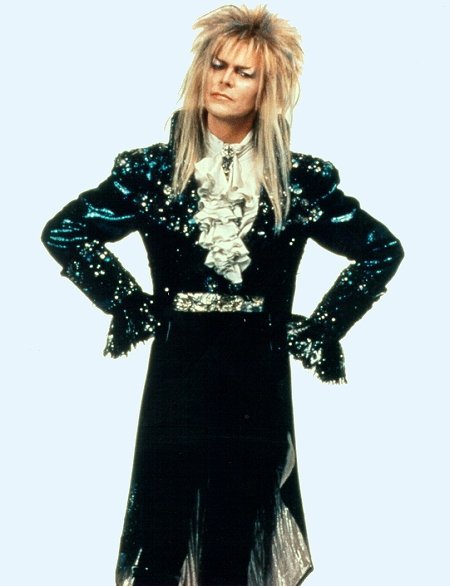
Kinda sounds like this guy:
-
Pixelized
-
The usual dreams, the usual schemes
Same lost feelings, same bad day dreams
Only unreal and delirious,
Out of breath and out of luck
[Sometimes] when I wake up slowly
[Paralysed] by the fears within me
Waiting for today to happen
Waiting for a vague impression
Waiting for today to happen
Waiting here with nothing but disaster
[Nailed tight] in his bed forever
[Turn out the lights] tomorrow, whatever
I’m so hung over with sleep
All I want to do is dream and dream and dream
Just lie down and never leave
Put myself here at your knees
[Sometimes] , when I wake up slowly
[Paralysed] by the fears within me
Waiting for today to happen
Waiting for a vague impression
Waiting for today to happen
Waiting here with nothing but disaster
[Nailed tight] in his bed forever
[Turn out the lights] tomorrow, whatever -
an early fave from the new album. had acquired a taste for humbug so yeah, this new one is good. needless to say, i miss their old sound, but bands evolve.
*thank you lustformusic and FYRBIB for the links
-
[youtube https://www.youtube.com/watch?v=FrIB5Ojbqns?feature=oembed&enablejsapi=1&origin=http://safe.txmblr.com&wmode=opaque&w=500&h=281]
aaw…makes you want to live in singapore
-
Trash the Movie
ohhh…can’t wait!!
Raphael, Gardo and Rat on the big screen

‘Trash: the movie’ is a closely guarded secret no longer. The team has now been assembled: Working Title with Peapie Films – Richard Curtis to write the screenplay, and Stephen Daldry to direct. Andy will be a consultant, but is quite clear about what that means.
‘I’m not involved. I’ve had several meetings and conversations with these gentlemen now, and I have to say the book couldn’t be in better hands – there’s a real intelligence and sensitivity coming through. Hardly surprising…
More on this here
-
Parallel World by Ji Lee

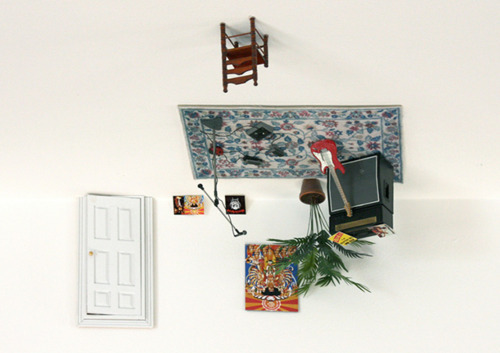
“The room started because I found this Jimi Hendrix doll at a toy store. It was him playing his guitar and it came with all kinds of detailed objects: mike, amp, pedals with wire and everything. So I bought it and threw Jimi out and started to build the room around those objects.”
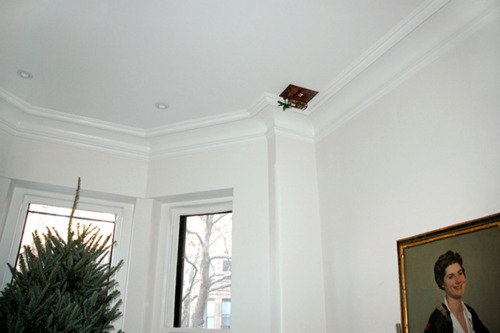

“Decorating ceilings was a celebrated art form in the past centuries that somehow got lost through the reductionism of modernism,” Lee writes. “I wanted to bring a small wink to this space. I also liked the idea that somehow there’s a parallel world which coexists with ours.”
-
The Goblin Companion by Brian Froud & Terry Jones
Up until now our scanty knowledge of goblins has been based on speculation, but we now know a great deal more, thanks to an important archaeological find of forty-three notebooks created by Dashe, a goblin portraitist. These notebooks are sketchy, but years of painstaking reconstuction by the eminent part-time goblinologist Brian Froud, backed up by years of dry research by his colleague, the noted academic Terry Jones, have amounted to an illustrated Who’s Who of the goblin world.
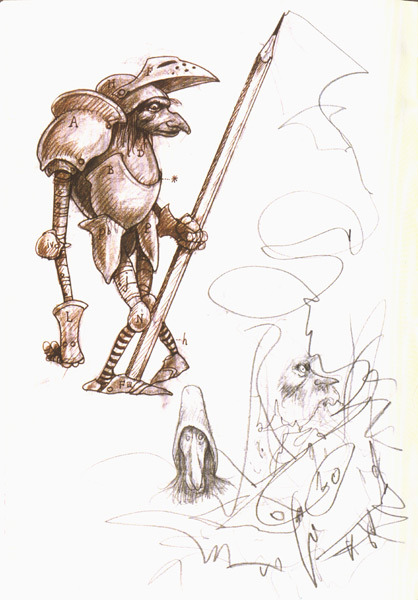
Brian Froud -The Human Artist
Little did Brian Froud think, when he undertook this work, that he would encounter so much opposition from the goblins themselves. Suffice it to say that he found it necessary to don armour. But even then he found himself unable to deal with the concerted attempts of goblins to wreck his work by forcing him to drink more and more really good wine, and then, while he was otherwise occupied, crawling across his pages with inky feet.
Prematurely aged, the artist finally gave up in despair and abandoned his work to the goblins themselves … and to the Pouilly Fuissé….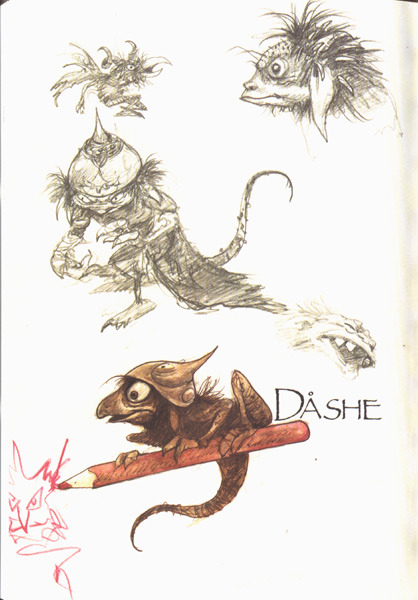
Dåshe
It is thanks to the quick pencil of Dåshe that we have any portraits at all of any of the goblins. It was the discovery of Dåshe’s notebooks (forty-three in all) containing lightning portraits of his friends and contemporaries that enabled Brian Froud, the human artist, (see page 121), to render the representations of the goblins that you see in this volume.
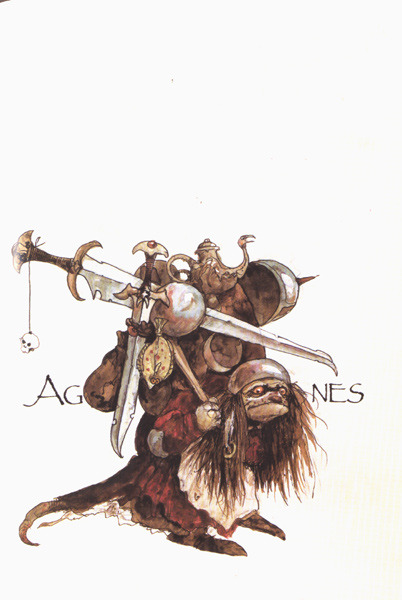
Agnes
Agnes is one of the many scavenging goblins that inhabit the Wide Tract of Rottenness that was formed after the Great Collapse of Good Governance in the Labyrinth (see note on Bübl, page 18).
Agnes is capable of collecting and carrying seventy times her own weight in discarded economic theories and abandoned political objectives. The empty promises, hollow opinions, and worthless public statements that litter the Wide Tract are all snapped up by this voracious creature. She then delivers them to Gürdy the Burnisher (see page 66), who polishes them up as good as new, if not better, and resells them to the ambitious and unscrupulous of all ages.
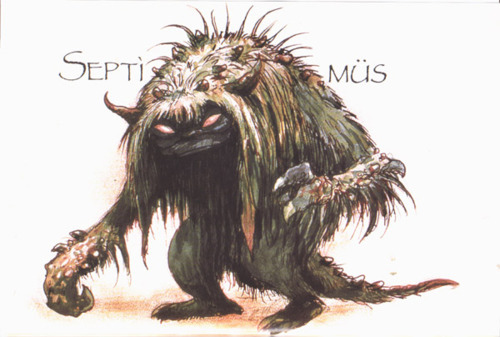
Septimüs
Septimüs is a typical Night-Troll. He steals silently and stealthily around people’s gardens and under bridges when the stars and moon are hidden by clouds and night is thickest. He is a terrifying and unnerving sight, or rather he would be if you ever saw him, but he is so silent and so stealthy and his visits so brief that nobody ever knows he’s there or even not there (see Bregg the Poet’s “Ode to a Twark’s Egg,” page 79)… and that’s the worrying part.
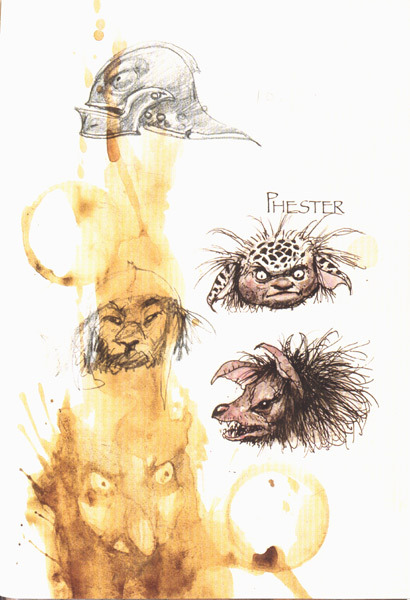
Phester
A very unpleasant goblin. Being very small, he is capable of climbing into an adult animal’s open sore, entering the bloodstream, going once around the system and out again, leaving a small trace in the heart that creates the impression of being in love – but with no particular object for your affection. Most unsettling.
More of these critters here
-
[youtube https://www.youtube.com/watch?v=ziR2EaQOSjU?feature=oembed&enablejsapi=1&origin=http://safe.txmblr.com&wmode=opaque&w=500&h=281]
これは僕達だ, 兄さん. 飛びましょう!